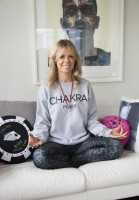
When modern American philosopher Daniel Pinchbeck met Jana Astanov, it was a meeting of minds – and hearts. Now, they are introducing left field think tank the Center for Planetary Culture, and emerging as New York City’s alternative power couple. Images: Mark C O’Flaherty. Shot on location at Silvershed.
 Last month, at the sprawling TriBeca loft of Giancarlo and Stephanie Canavesio, maverick New York philosopher Daniel Pinchbeck launched his latest project, a think tank named the Center for Planetary Culture. The event drew his usual crowd of socially conscious entrepreneurs, left field politicos and trust fund darlings, who sipped libations prepared by molecular biologist Alex Ott and listened intently as Pinchbeck, along with panelists Carne Ross and Peter Buffett, laid out the blueprint for this latest mission.
But there was one notable addition to the scene – Pinchbeck’s new wife, Jana Astanov, whom he repeatedly referred to as Creative Director of the project, and who hovered on the side-lines, just shy of the spotlight. A beautiful blonde in a silk cheongsam, the couple met at last year’s Burning Man festival, and were married a few months later in a discrete ceremony she describes as “really small and very sweet”, after he apparently pulled out all the stops to convince her to stay in New York with him.
Born on Friday the 13th in Poland’s Masurian Lake District, known as “land of a thousand lakes” – “It’s the area with one of the oldest European forests,” she says. “I remember reading somewhere that in some parts of Masuria, Pagan cults were present up until the 19th century. As kids, sometimes running though the forest we would come across strangely aligned stones that seemed to be old Pagan altars. I feel like growing up there gave me a special connection to nature.” And the way in which Astanov seems to have bewitched Pinchbeck suggests a certain siren’s call.
But it’s likely her ferocious intellect that her new husband finds truly mesmerizing. In her previous life, she had a successful career working for one of the world’s biggest engineering corporations, but her mind-boggling academic resume includes studies in political science, sociology, anthropology, a scholarship to read philosophy in France, and a degree in translation. She also attended art school in Poland, and took a masters in Media Production at the University of the Arts in London and has challenged herself “to learn a new language every two years.” She laughs; “I’m like the circus person who can do a bit of everything.”
Now she is poised to take New York City, and become an important voice in the movement for the evolution of consciousness. Over an orange juice at the Americano Hotel in Chelsea, tired but elated after a weekend celebrating her husband’s birthday at Philadelphia’s Freeform festival, we settle to discuss Planetary Culture, the magic of Burning Man and life as the wife of one of our most notorious modern thinkers.
 So how did you have the idea for the Center for Planetary Culture? “I’d got to a point in my life where I was completely burned out from my job in engineering, and I had taken some time out to restore my wellbeing. Before I even went to Burning Man and met Daniel, I had a deep spiritual experience in which I journeyed into the future in a dream, and somehow I knew I wouldn’t be going back to my old career. I actually had the revelation that I should be involved in creating a foundation for cutting-edge thought. At first, I wanted to set up a scholarship program at my university in Poland. Later, it seemed natural to do this in New York, with the opportunities available here.”
And is this what morphed into the idea for the think tank? “At around the same time, Daniel had received a grant from Tides Foundation, and Peter and Jennifer Buffett suggested that we start a think tank representing a transformative vision of human possibility. Most of the influential think tanks are quite right wing. For Daniel, it seemed an obvious progression after co-founding Evolver.net. Before we started I made an analysis of what worked and what didn’t with Evolver, and based on that we defined the strategy for our new project.”
But you came up with the name? “While reading Daniel’s 2012: The Return of Quetzalcoatl

Mr and Mrs Pinchbeck in Burning Man mode
What’s the central mission of the think tank? “Our goal is to help provide a new vision as well as a strategic plan for how human civilization can evolve to become ecologically regenerative and socially just. We believe that climate change, ocean acidification, species extinction and other threats facing us as a species can be an initiatory opportunity to shift to a cooperative rather than a competitive paradigm. People like to think of Daniel as a poster child for psychedelics – at parties it’s often all people want to talk to him about, even within the NYC elite. Maybe it’s the topic of choice because it’s easier than the real conversation about how to change society. But he is an American philosopher, and his new book is also about ways to transform our current civilisation to create a new vision for humanity.”
Which it could be argued is a very utopian vision… “It is, although many other thinkers share it as well, such as Barbara Marx Hubbard and Duane Elgin. Some might consider it utopian. I would say that what Daniel does is to create an imaginary framework to show the potential for us all to lift ourselves to a higher level of consciousness and really share the world. So through the think tank, we will create papers and Wikis that ask, and seek to answer, the question: ‘What can we do to bring planetary culture into fruition, and see our world transformed?’”
What’s your role specifically? “As Creative Director, I define our visual identity, and I am also contributing to the choice of topics for our research papers. But my personal passion is the Intentional Art section, which we are creating in collaboration with the Danish artist Jacob Fuglsang Mikkelsen. We are developing a database of artists who are making relevant work that evokes our current precarious situation on the Earth, presents a positive vision of the future, or makes you think differently about human potential. I believe in the power of art as a medium that can help us see reality from a different perspective.”
Do you see yourself as an Intentional Artist yourself then? What kind of projects are you developing? “Ultimately, yes. I am currently working on a Tarot deck project, translating a 16th Century deck, with its Ancient Greek and Christian references, to a set of images that would be more relevant to the values and spiritual meaning of the 21st Century. It turns out that the occultist interpretation of Tarot was only added in the 19th Century and linked to Ancient Egyptian hermeticism and Kabala. I see it more as a social game that draws from the collective consciousness. I am currently developing the aesthetic, which may take a number of forms.”

An image from Jana’s Festival Tribes portrait series, shot on location in Maui.
You’re also a talented photographer, and obviously have a lot to give yourself, but you seem committed to furthering your husband’s vision – which could be seen as quite old fashioned. Would you describe yourself as a feminist? “Yes I am, but there are so many problems with the structure of this question and the implied meanings. Would you ask a man to quantify his position on gender in the same way? With Daniel, we co-founded the think tank and defined the mission and the vision as a team. But still it’s not easy to be educated and female in a man’s world – and the world IS still run by men, anywhere there is power and money involved: in politics, money and finance, the world’s largest industries, it’s all white guys in their 50s and 60s. These are the people who are deciding the fate of the world, and what do they care about? Mainly their own families. As long as they’re wealthy and healthy, they don’t think about caring for anybody else or the future of the planet. When we held our launch at Giancarlo’s loft, the media activist Laura Dawn challenged the three men on the panel, noting that as testosterone causes aggression, there needs to be at least 30% women on any public discussion or corporate board. I think she made a great point!”
You seem pretty disillusioned by your experience of corporate life… “My experience revealed how corporations will just use people up. All around me, I saw people overworked, hypnotized by their jobs, their bodies breaking down from 100 hour work weeks. It didn’t feel human. At the same time, the people I worked with ridiculed the idea of ecological sustainability. It was painful to be part of, but it was the world I knew. On the other hand, it was very exciting to contribute to some of the largest infrastructure projects in the world, and experience life in Istanbul, Abu Dhabi, Muscat, Hong Kong. But when I came back from a project in Asia with a terrible flu, a series of medical tests showed that I was in dreadful physical condition for somebody my age and I knew my body was telling me to stop.”

Another images from Jana’s Festival Tribes portrait series.
And after all of those years in the corporate world, what did you think of Burning Man? “I only found out about Burning Man a month before the festival. A friend – a Gemini like Daniel – invited me to come with her, and organized everything for us. When I first read the rules, I through this can’t be true – it’s crazy, such a utopian vision, but what I liked the most about it was being a part of a social and artistic project. The festival itself is a creative expression of humanity, and being surrounded by so much art actually starts to rewire the brain. We are learning more and more about neuroplasticity, and I think when you encounter so much novelty, it can actually recreate your neurological pathways, making you more open to new ideas and experiences.”
And how and when did you first encounter Daniel? “My friend had a series of lectures she wanted to attend and one day she came back from a talk, raving about it. She said the speaker had covered many ideas that she had but had never heard expressed before. His next talk was at midnight – and who goes to a two-hour philosophy lecture at Burning Man at midnight? It seemed ridiculous, but she convinced me to go. As soon as I saw Daniel, he reminded me of one of my closest friends, an abstract painter in Paris. We chatted before his talk, and he invited me to stay afterward. Perhaps he was intrigued by my accent and my outfit – I was dressed like the robot from Metropolis, and wearing a purple wig. We ended up spending the whole night wandering the desert together, and were inseparable for the rest of the week – and ever since.”
Was it an instant meeting of minds? “Actually, it was. I’ve studied philosophy in Poland and France and I thought I knew a bit, but he had all these new references and quoted thinkers I’d never heard of, like Terence McKenna, Gurdjieff, and Bruce Lipton. I was annoyed! But when we spoke afterwards, we discovered we shared an interest in many thinkers, like Hegel, Foucault, as well as the Frankfurt School.”
What kind of impact have you had on each other’s lives? “As for our personal life, it feels as if the Universe listened to Daniel’s prayers. The night we met, Daniel was supposed to take part in a guided journey led by Michael Ellsberg to open his heart chakra so he could find and receive love…Weeks later, during our wedding reception, Michael told me that my appearance that night felt like the embodiment of Daniel’s intention. Daniel’s mom Joyce also told me he had been craving a real partnership for quite some time.”
What does this look like in your daily life together? “I think I have provided a lot of emotional stability, and I’ve also been convincing him to do yoga and meditation with me. Daniel is a classic intellectual in that it is sometimes hard for him to get into his body. He has been introducing me to his friends from all over the world – mystics, MIT chemical engineers, poets, famous rock and roll managers. We really enjoy exploring many different worlds and dimensions together. I think he loves my old world European background, and we both appreciate each other’s sense of humor a lot. We are still learning about each other though, and like any couple we have rough patches.”
 You’re kind of the alternative power couple. Does it feel that way to you? “Not really. Actually, we feel that many of the people that our culture puts into the spotlight, whether in the mainstream celebrity culture, the art world, or the post-New Age spiritual scene don’t really take enough responsibility, by simply accepting the status quo. I admire people like Starhawk, Vivienne Westwood, David Lynch, Eve Ensler, and Russell Brand, who use their position of influence to inspire people and create new forms of social and spiritual engagement. Revolution in the old sense won’t work now, but we need to find ways to transform our society to deal with the ecological crisis and social inequality. I sometimes wish we could just travel the world and make art, but we both seem to be work junkies, obsessed with always doing more. It makes me wonder if we might have a karmic responsibility for future generations.”